The Year on the Bottom
How to Read the Production Year from the Marks on a Rozenburg Piece
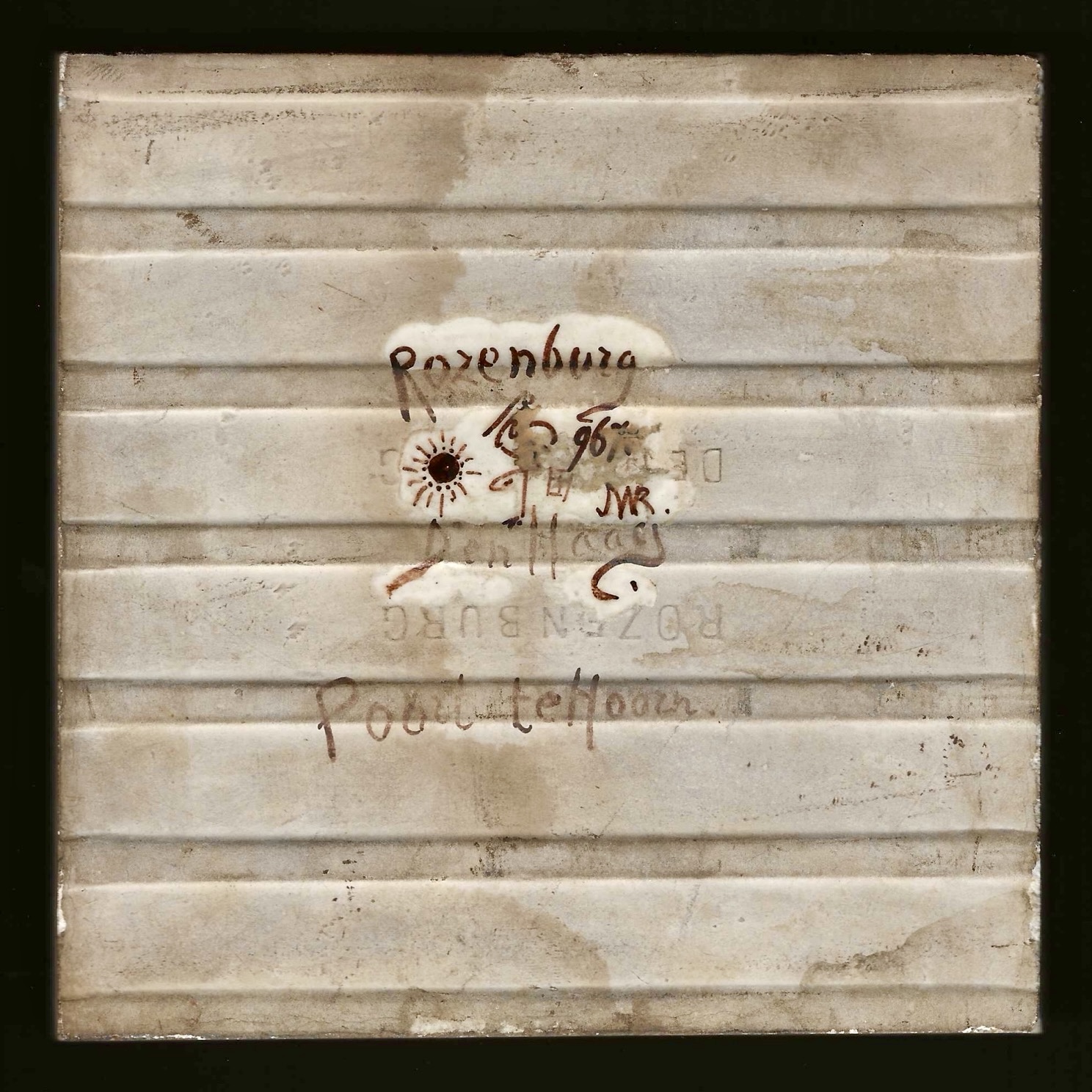
Turn a piece of Rozenburg over and you'll find more than a signature. Beside the factory mark, there is often a small sign that reveals the year of production — at first a letter, later a symbol such as an anchor, a bee, or a sun. This is how that system works.
Rozenburg marked his work carefully. On the bottom of a vase or tile, there are usually several marks together, and it is worthwhile to sort them out. One of them tells, once you recognize it, quite precisely in which year the piece was made.
First, the Factory Mark
The permanent mark is that of the factory itself: the name Rozenburg with den Haag, usually together with a stork and a crown. The stork refers to The Hague, which bears the bird in its coat of arms. This mark tells where the piece comes from, but not when.
From Letters to Symbols
For the year, Rozenburg used a separate year mark. In the early years, this was simply a letter, which changed each year:
A = 1885, B = 1886, C = 1887, D = 1888, E = 1889, F = 1890, G = 1891, H = 1892, K = 1893, L = 1894 and M = 1895.
In 1896, the factory abandoned the single-letter system. The years 1896–1897 represent a transition with composite letter marks (such as NK and a K with a small diamond in a circle). The first true symbol followed at the end of 1897: to mark the inauguration of Queen Wilhelmina, Rozenburg chose a crown as the year mark for 1898. After that, the series of figurative marks became recognizable year by year:
The Symbols in Order
- 1898 — Crown (at the inauguration of Queen Wilhelmina)
- 1899 — Anchor
- 1900 — Bee
- 1901 — Ant
- 1902 — Sun
- 1903 — Star
- 1904 — Flag
- 1905 — Fleur-de-lis
- 1906 — Double Axe
- 1907 — Hourglass
- 1908 — Scales (Libra)
- 1909 — Torch
- 1910 — Torch (again)
- 1913 — Small Tree
- 1914 — Moon (first quarter)
Two Years Without a Mark
In 1911 and 1912, Rozenburg used no year mark. If you find a piece from this period without a year symbol, that is not a mistake but the rule. For dating, you then have to rely on other clues — for example the work order number.
How to Use It Here
In the work order overview, you can filter by year mark, so that you see all the work from one year together. And because each year mark is linked to a production year, it works the other way around too: read the symbol on the bottom, and you know the year — and often, via the work order number, even the exact work order.
Note: marks wear, run into the glaze, or are written by hand slightly differently each time. If you are in doubt, compare with other dated pieces — the list above is your guide.
Sources: Jaarmerken Rozenburg (1885–1914), zoals vastgelegd op deze site · Merken-hoofdstuk in de monografie Rozenburg (Haags Gemeentemuseum) · Het werkorder-overzicht koppelt elk jaarmerk aan het bijbehorende jaar.