
ROZENBURG Large plaque painted after Gerard Terbor
Tile panel · work order 698
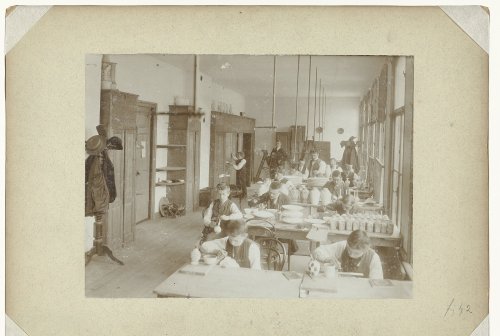
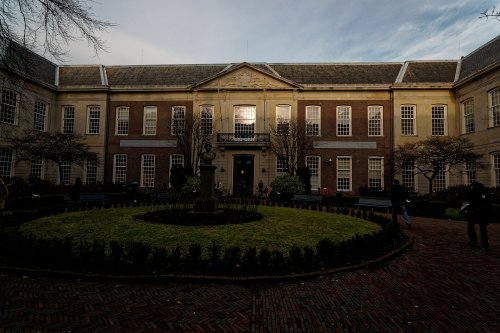
Daniël Harkink was there from the very beginning. He was the son of a Gouda joiner and grew up in The Hague and Delft. He first drew for a carpet factory, attended the The Hague Academy from 1879 to 1882 and then studied under Adolf le Comte at the Polytechnic School in Delft. He learned pottery painting in practice at De Porceleyne Fles. There he met Wilhelm Wolff von Gudenberg. When the latter started his own factory in The Hague in 1883, Harkink went with him. The register puts his entry into service on 20 October 1883; he was twenty at the time.
In the early years Harkink was the linchpin of tile production. He was not only a painter but also technically versed in ceramics, and he helped the young artists who had a studio at the factory get to grips with the decorating techniques. With Willem de Zwart he painted a winter view of Utrecht that bears both their names. His own speciality was painting after great masters. There is a tile panel “Dance in the barn” after Bega (1888) and a wall plate from 1889, signed “D. Harkink after E. Verveer”. In 1891 he painted a tableau of Princess Wilhelmina in mourning dress, around 1892 the tableau of the board of the Oudemannenhuis after Gerke Henkes, in 1893 The Beautiful, the True and the Good after a design by Georg Sturm (Rijksmuseum), and around 1895 a tableau of 234 tiles depicting the factory itself, for the showroom on the Parkstraat (Haags Historisch Museum). In the second half of the 1890s he became captivated by Rembrandt’s chiaroscuro. This site features, among others, a large plate after Gabriel Metsu, a seascape after Mesdag and the interior of the Great or St James’s Church after Bosboom in his name.
A personal detail from the register: Koosje Moret, whom Harkink married in 1898, herself appears in it as an apprentice in 1896.
At the end of 1900 Harkink left after an artistic conflict. Until the age of 62 he worked at Plateelbakkerij Zuid-Holland in Gouda, as a painter and designer, but also as artistic director and head of the laboratory. There he became the spiritual father of the successful matt-glaze pottery and designed the Damascus and Rhodian decorations. In 1910 the women’s magazine De Lelie called him “the best tableau painter on tiles in Holland”. Of his Gouda tableaus, the Night Watch (1902, Museum Gouda) and two tableaus with a potter (1918, façade of the Koningshof) have survived. After retiring he painted landscapes. In 1941, at the age of 78, he made his debut with a solo exhibition. A year later came a tribute exhibition at Panorama Mesdag.
Sources: RKD 36046 · Wikipedia, "Daniel Harkink" · Museum Goedewaagen, "Rozenburg legkast B — Daniël Harkink en andere Haagse schilders voor 1890", "Rozenburg tegeltableaus 1892–1899" en "Rozenburg monochrome tableaus 1892–1895" · Haffmans Antiek, wandbord 1889 · brief H.D. Schild, 1912 (RKD, excerpt 34)
Listed on list A (1883–1889), age 21–26. Actual period at Rozenburg unknown; level not recorded.
Employed 20 Oct 1883 (age 20)until 21 Dec 1900 (age 38)
ROZENBURG Large plaque painted after Gerard Terbor
Tile panel · work order 698

GROSSE BILDPLATTE NACH GABRIEL METSU
Other · work order 635

A LARGE ROZENBURG PORCELAIN PLAQUE
Tile panel · work order 680a

Tile panel · work order 846

Maritime Scene - Hendrik Willem Mesdag
Tile panel · work order 968

Rozenburg. Pottery Tile: Pastoral Scene
Tile panel · work order 968
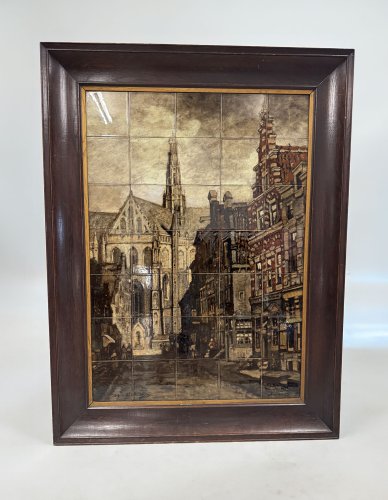
Rozenburg tegeltableau, stadsgezicht Haarlem naar Klinkenberg, beschilderd door Daniel Harkink
Tile tableau · work order 337

Rozenburg, Village Scene with Houses, Boats
Other · work order 1158
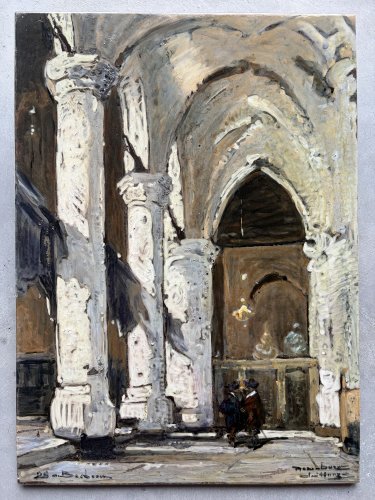
Interieur van de Sint-Jacobs kerk in Den Haag - naar Bosboom
Tile panel · work order 1532
In the Rozenburg work order books, Daniël Harkink is named on 422 work orders, from 1893 to 1900; on 373 of them as the only painter.
earthenware (169) eggshell porcelain (3) tiles (236) other (14) Click a year to see the work orders of that year.
★ = work order with an object on this site. Click a work order number to see what the work order book tells about it. Source: the Rozenburg work order books (The Hague Municipal Archives).