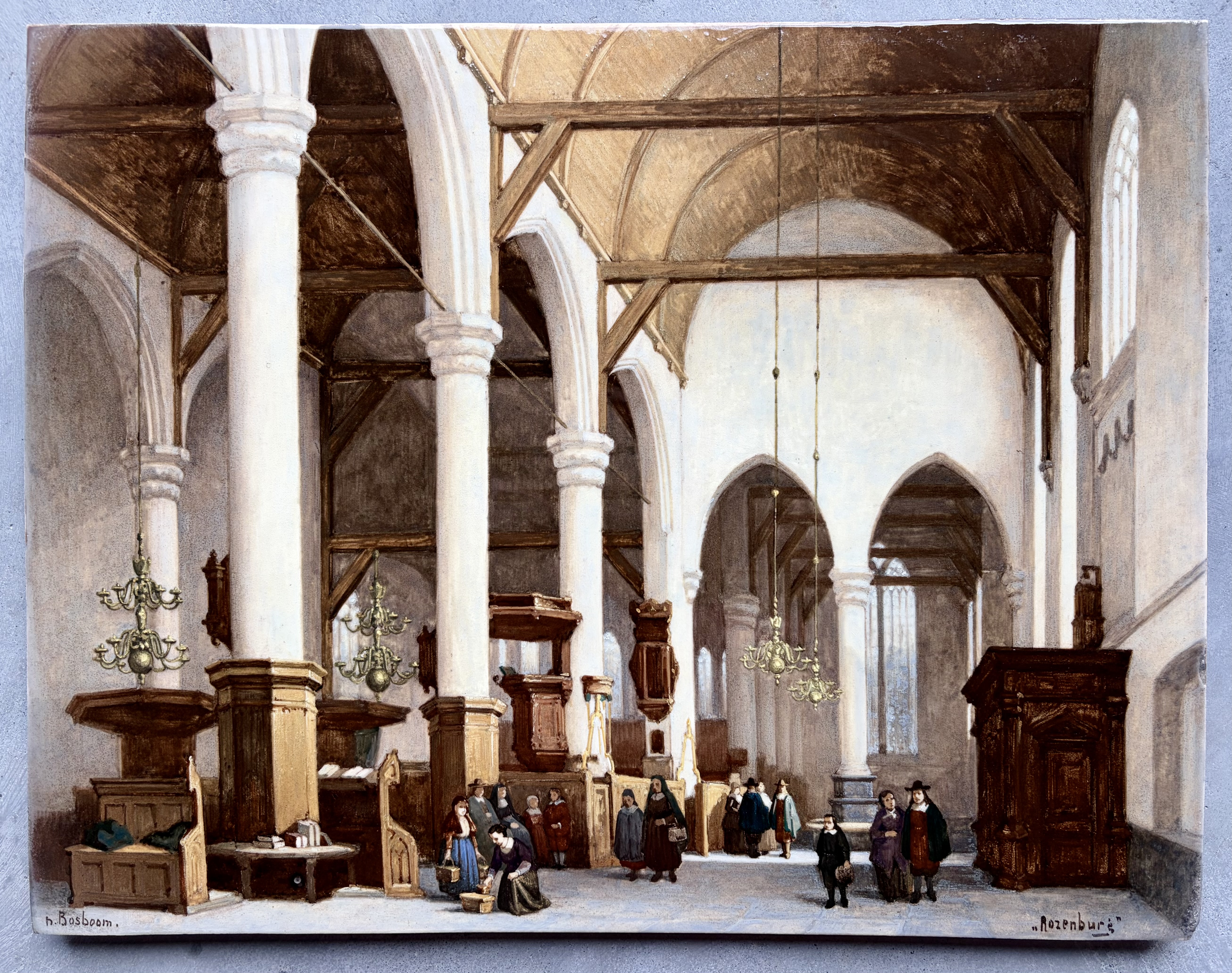
Tile panel
Interior of a Dutch Church after Johannes Bosboom
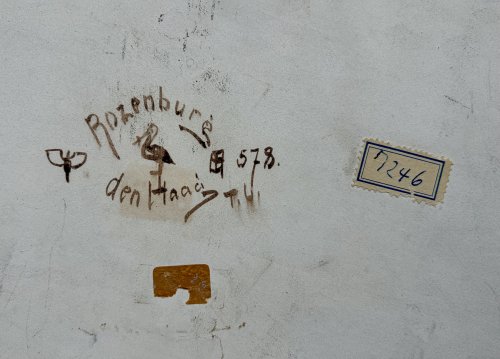
- Work order
- Work order 578 · book 710, p. 17
- Painter
- Coesel, Thomas
- Year mark
- Dubbele bijl (1906)
- Dimensions
- H 31 cm × B 40 cm × D 1 cm
Description
This tile represents a masterful example of the refined painterly work of the Hague Plateelbakkerij Rozenburg. Depicted is a spatial church interior with monumental architecture of white columns, wooden roof trusses and a barrel vault. The composition is distinguished by an exceptional eye for detail: from the brass chandeliers hanging from the high vault arches to the warm, carved oak furniture and the pulpit. In the foreground, various groups of figures in seventeenth-century dress move about, reinforcing the historical and everyday character of the space. Through a sublime use of perspective and soft light, the master painter has succeeded in combining the cool monumentality of the church space with an intimate, serene atmosphere.
On Johannes Bosboom (1817–1891)
Johannes Bosboom is considered one of the most important precursors and masters of the Hague School. He acquired international fame with his atmospheric depictions of church interiors, drawing inspiration from seventeenth-century Old Masters such as Emmanuel de Witte and Rembrandt. Bosboom, more than anyone else, was able to capture the unique light, the tranquility and the spacious emptiness of historic Dutch churches on canvas and paper. His style varied from apt and sketchy to extremely refined and detailed. Around the turn of the century, the Hague factory Rozenburg issued a series of high-quality earthenware tiles on which Bosboom's iconic church interiors were translated and immortalized in glaze with remarkable precision.