Work order 578
- Year mark
- Dubbele bijl (1906)
- Dating
- October 19, 1906
- Order book
- 710, part 1, page 17
- Painter(s)
- Coesel, Thomas
- Order
- Plaque · size 31 × 40 · 1 piece
- Cost price
- ƒ21.60 per piece · What it cost ↓
Objects (1)
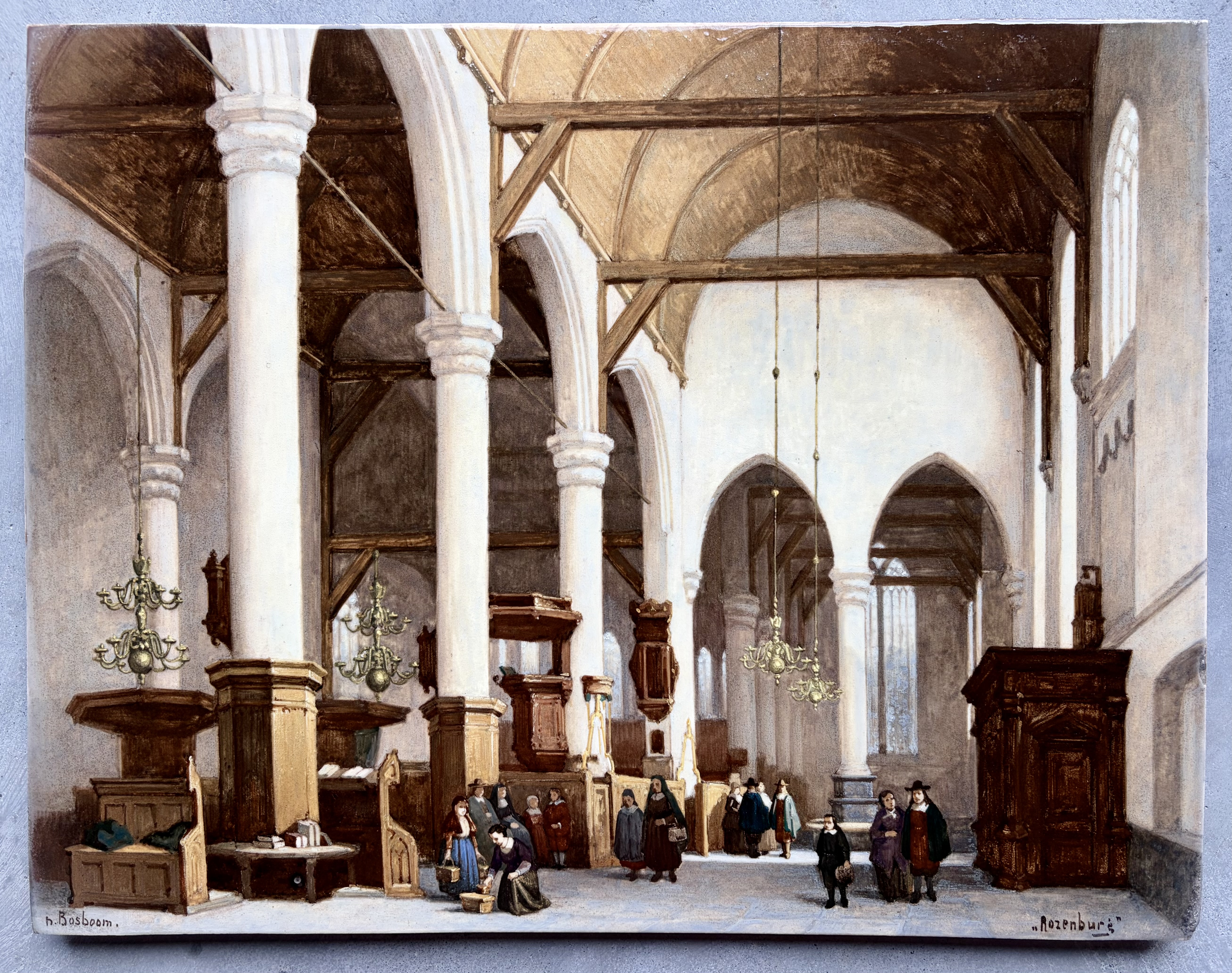
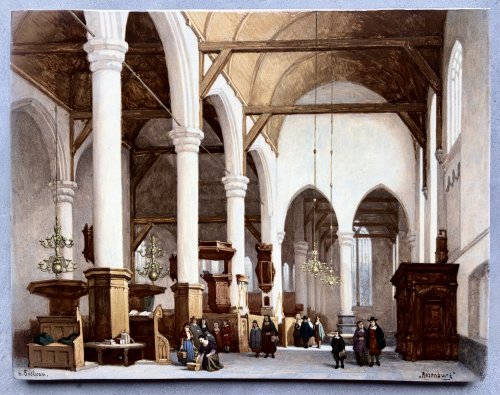
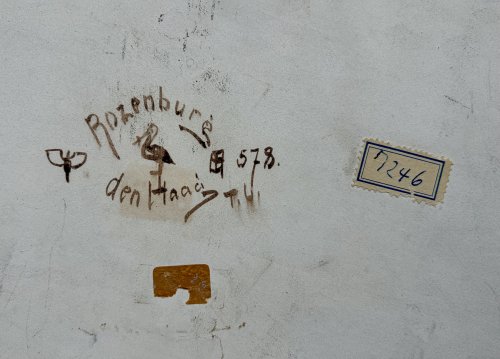
Tile panel✦ In my collection
Interieur van een Hollandse kerk naar Johannes Bosboom
This tile represents a masterful example of the refined painterly work of the Hague Plateelbakkerij Rozenburg. Depicted is a spatial church interior with monumental architecture of white columns, wooden roof trusses and a barrel vault. The composition is distinguished by an exceptional eye for detail: from the brass chandeliers hanging from the high vault arches to the warm, carved oak furniture and the pulpit. In the foreground, various groups of figures in seventeenth-century dress move about, reinforcing the historical and everyday character of the space. Through a sublime use of perspective and soft light, the master painter has succeeded in combining the cool monumentality of the church space with an intimate, serene atmosphere.
On Johannes Bosboom (1817–1891)
Johannes Bosboom is considered one of the most important precursors and masters of the Hague School. He acquired international fame with his atmospheric depictions of church interiors, drawing inspiration from seventeenth-century Old Masters such as Emmanuel de Witte and Rembrandt. Bosboom, more than anyone else, was able to capture the unique light, the tranquility and the spacious emptiness of historic Dutch churches on canvas and paper. His style varied from apt and sketchy to extremely refined and detailed. Around the turn of the century, the Hague factory Rozenburg issued a series of high-quality earthenware tiles on which Bosboom's iconic church interiors were translated and immortalized in glaze with remarkable precision.
From the work order book
For every work order, Rozenburg recorded what was made, who painted it, when it went into the kiln and what it cost. This is what the work order book tells us about work order 578.
What was made
Plaque
size 31 × 401 piece
1 approved after firing
Who painted it
Coesel, Thomas
Painter in 1906
Painter's wages for this work order: ƒ15.04. Paid over 2 weeks.
What it cost
ƒ21.60
cost price per piece
70%
17%
- Biscuit (the unpainted body)ƒ1.869%
- Painter's wagesƒ15.0470%
- Paint and glazesƒ3.7617%
- Firing (coal and wages)ƒ0.944%
From order to kiln
- 19 Oct 1906Work order entered
- 19 OctPainter's wages paidƒ7.44
- 26 OctPainter's wages paidƒ7.60
- 29 OctGlazed1 piece
- Fired in kiln 16· 1 approved
From order to the last step recorded in the book: 10 days.
Source: work order book 710, part 1, page 17 of the Rozenburg pottery, The Hague Municipal Archives (access 0249-01). How these data were compiled ›