
Tile panel
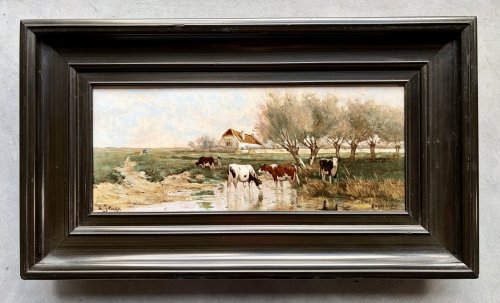
Panoramic Polder Landscape after Jan Vrolijk
- Work order
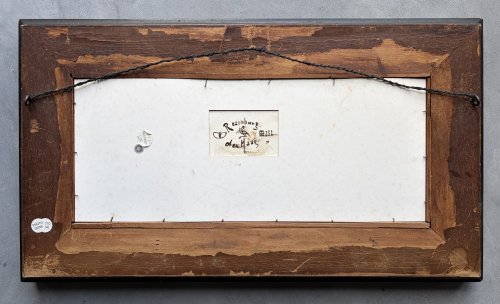
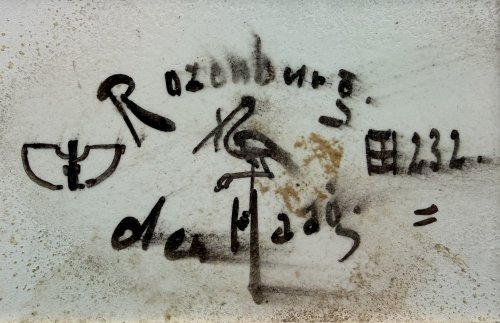
- Work order 232 · book 709, p. 84
- Year mark
- Dubbele bijl (1906)
- Dimensions
- H 47,5 cm × B 19,5 cm × D 1 cm
Description
This tile panel represents a masterful example of the refined painterly work of The Hague Plateelbakkerij Rozenburg, executed after a work by Jan Vrolijk. Depicted is a characteristic Dutch meadow landscape in which a couple of cows seek cooling by a pond at the edge of the ditch. The broad, panoramic composition is striking in its balanced and atmospheric composition: on the right side stand graceful pollard willows with their silvery-grey foliage, while in the background a rural farmhouse rests beneath a lightly clouded sky. A farm woman with the cattle and a narrow sandy path that stretches toward the horizon reinforce the spatial quality of the scene. With a harmonious palette of natural greens and earth tones and an eye for the anatomy of the cattle, the master painter has captured the rustic, rural atmosphere of Vrolijk's oeuvre excellently in glaze.
About Jan Vrolijk (1846–1894)Johannes Martinus (Jan)
Vrolijk ranks among the leading cattle and landscape painters of the Hague School. He acquired great renown with his atmospheric depictions of the Dutch meadow landscape, in which grazing and drinking cattle invariably formed the focal point. Vrolijk had the rare gift of capturing the subtle reflections of water, the soft fall of light and the convivial rural life with great precision on canvas, paper and copper. His work is characterized by great sensitivity to nature and a masterful anatomical rendering of cattle. Around the turn of the century, the Hague factory Rozenburg brought out a series of high-quality earthenware tile panels on which Vrolijk's beloved polder and cattle scenes were translated and immortalized in glaze with remarkable precision.