Work order 232
- Year mark
- Dubbele bijl (1906)
- Dating
- April 13, 1906
- Order book
- 709, part 2, page 84
- Order
- Plaques · size 48 × 20 · 13 pieces
- Cost price
- ƒ10.80 per piece · What it cost ↓
Objects (1)

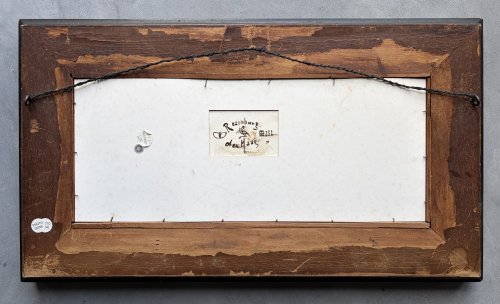
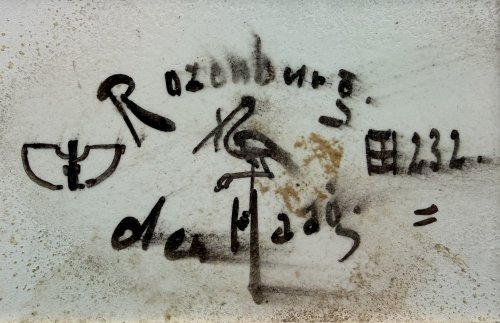
Tile panel✦ In my collection
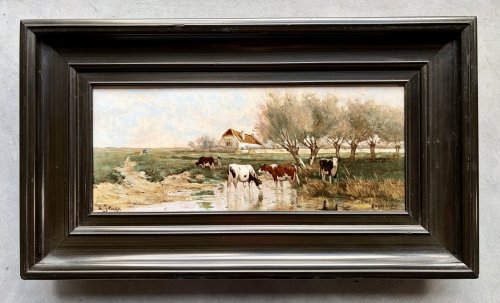
Panoramisch polderlandschap naar Jan Vrolijk
This tile panel represents a masterful example of the refined painterly work of The Hague Plateelbakkerij Rozenburg, executed after a work by Jan Vrolijk. Depicted is a characteristic Dutch meadow landscape in which a couple of cows seek cooling by a pond at the edge of the ditch. The broad, panoramic composition is striking in its balanced and atmospheric composition: on the right side stand graceful pollard willows with their silvery-grey foliage, while in the background a rural farmhouse rests beneath a lightly clouded sky. A farm woman with the cattle and a narrow sandy path that stretches toward the horizon reinforce the spatial quality of the scene. With a harmonious palette of natural greens and earth tones and an eye for the anatomy of the cattle, the master painter has captured the rustic, rural atmosphere of Vrolijk's oeuvre excellently in glaze.
About Jan Vrolijk (1846–1894)Johannes Martinus (Jan)
Vrolijk ranks among the leading cattle and landscape painters of the Hague School. He acquired great renown with his atmospheric depictions of the Dutch meadow landscape, in which grazing and drinking cattle invariably formed the focal point. Vrolijk had the rare gift of capturing the subtle reflections of water, the soft fall of light and the convivial rural life with great precision on canvas, paper and copper. His work is characterized by great sensitivity to nature and a masterful anatomical rendering of cattle. Around the turn of the century, the Hague factory Rozenburg brought out a series of high-quality earthenware tile panels on which Vrolijk's beloved polder and cattle scenes were translated and immortalized in glaze with remarkable precision.
From the work order book
For every work order, Rozenburg recorded what was made, who painted it, when it went into the kiln and what it cost. This is what the work order book tells us about work order 232.
What was made
Plaques
size 48 × 2013 pieces
13 approved after firing
Who painted it
Frauenfelder, Hendrik
Painter in 1906
Soonius, Lodewijk
Painter in 1906
Weij, Leenderd de
Painter in 1906
Knikker, Aris
Painter in 1906
Painters' wages for this work order, together: ƒ91.31. Paid over 7 weeks.
What it cost
ƒ10.80
cost price per piece
13%
65%
16%
- Biscuit (the unpainted body)ƒ18.7213%
- Painter's wagesƒ91.3165%
- Paint and glazesƒ22.8316%
- Firing (coal and wages)ƒ7.525%
From order to kiln
- 13 Apr 1906Work order entered
- 20 AprPainter's wages paidƒ8.40
- 27 AprPainter's wages paidƒ4.80
- 4 MayPainter's wages paidƒ17.46
- 11 MayPainter's wages paidƒ20.79
- 14 MayGlazed3 pieces
- 18 MayPainter's wages paidƒ18.28
- 21 MayGlazed3 pieces
- 25 MayPainter's wages paidƒ14.62
- 28 MayGlazed3 pieces
- 1 JunPainter's wages paidƒ6.96
- 4 JunGlazed4 pieces
- Fired in kiln 8· 6 approved
- Fired in kiln 9· 7 approved
From order to the last step recorded in the book: 52 days.
Source: work order book 709, part 2, page 84 of the Rozenburg pottery, The Hague Municipal Archives (access 0249-01). How these data were compiled ›